EPF Conference, Shanghai
Captain’s Log — Stardate 61021.8
At the summons of Admiral Dong Lai, whose reputation alone was sufficient to mobilize a fleet, approximately three hundred astronomers from across the world converged in Shanghai for a joint expedition on exoplanets and planet formation.
Among the assembled senior officers were figures long regarded as pillars of the field, including Admirals Thomas Henning and Doug Lin.
The mission scope was broad: from the earliest stages of protoplanetary disks to mature planetary systems, spanning theory, observation, and instrumentation.
The density of briefings was formidable. While the sheer number of talks offered a comprehensive snapshot of recent progress, it also imposed a significant cognitive load. The pace occasionally exceeded optimal absorption capacity.
A future deployment might benefit from parallel sessions or a reduced briefing schedule, allowing deeper engagement with individual topics.
Day 1 — Disk Reconnaissance
Initial reports focused heavily on disk physics and dust evolution. New observations and theoretical interpretations reinforced the emerging picture of disks as structured, dynamic environments rather than smooth, axisymmetric systems.
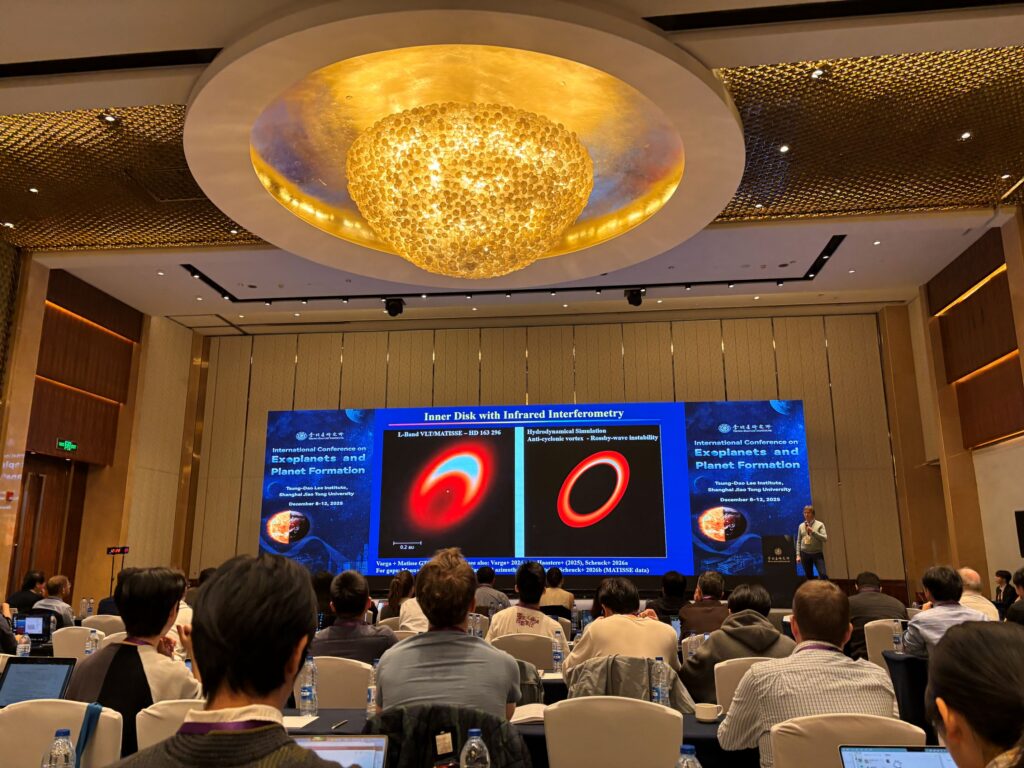
Admiral Thomas Henning presented compelling infrared interferometric observations of the inner regions of disks, highlighting HD 163296 as a case study. The inner disk, once thought inaccessible, is now being resolved with increasing clarity.
Admiral Yanqin Wu emphasized a persistent concern: the degeneracy inherent in SED fitting when constraining dust grain sizes. Despite decades of progress, no universally robust strategy has yet emerged to fully break this degeneracy — a reminder that foundational problems remain unsolved.
During a break between briefings, I encountered Admiral Doug Lin, my former undergraduate supervisor — a connection tracing back to what might be called an earlier Starfleet Academy assignment. Now in his seventies, he remains fully engaged, continuing to mentor young PhD cadets with undiminished energy.
Numerous informal exchanges with postdoctoral researchers and newly appointed assistant professors followed. These corridor-level interactions proved as valuable as the formal sessions, significantly expanding my professional network.
Day 2~3 — Exoplanets
These two days’ briefs focus more on exoplanets, which are not my field, but I still heard some impressive briefs. Admiral Laura Kreidberg introduced the concept of the cosmic shoreline, a framework linking planetary mass, stellar irradiation, and atmospheric retention. The idea is elegant and provocative, though its current boundary conditions remain imprecise.
Notably, debate over its definition continued even outside formal sessions, including during breakfast discussions — a sign of a concept still actively evolving.
Day 4~5 — Disk Physics Revisited
Later sessions returned decisively to disk-related themes. Of particular interest were discussions of dust leakage from pressure traps, highlighting that traps are not perfectly confining structures but semi-permeable features whose efficiency depends sensitively on grain physics.
Presentations by Captain Eve Lee and Lieutenant Thomas Pfeil underscored how fragmentation, drift, and trap leakage together shape dust distributions. These results resonated strongly with observational indications that different disk substructures may host distinct grain populations.
Preliminary Conclusions
Across the expedition, a consistent message emerged: while observational capabilities have advanced dramatically, interpretation remains limited by physical degeneracies and incomplete coupling between theory and data. Progress increasingly depends on careful synthesis across disciplines.
From the Captain’s perspective, the mission reaffirmed that the most productive insights often arise not from isolated breakthroughs, but from sustained dialogue between observers, theorists, and instrument builders — both in formal sessions and in the spaces between them.
Captain out